
Sourav here.
I am going to be very direct before I begin.
A year-end journal is not a place for corporate updates, achievements, or polite optimism. If we do that, we waste an opportunity. This is the one moment in the year where you are not looking for instructions. You are looking for meaning.
So this piece is not about Brainium as a company.
It is about Brainium as a group of humans who showed up every single day in 2025.
If this does not challenge, amuse, and slightly provoke our thinking, then it has failed.
So let me tell you a story.
The day I learned that confidence is rented, not owned
In 1999, I was selling UPS systems door to door in Bangalore.
No fancy title. No business card that opened doors. No LinkedIn profile. Just a bag, a price list, and a lot of rejection.
On my first solo day, I could not even convince the receptionist to let me meet the decision maker.
I remember walking back in the afternoon sun, sweating more from fear than from heat, thinking I had made a terrible career choice.
Here is the funny part.
Twenty six years later, when people see me today, they assume confidence is something I have always had.
That assumption is wrong.
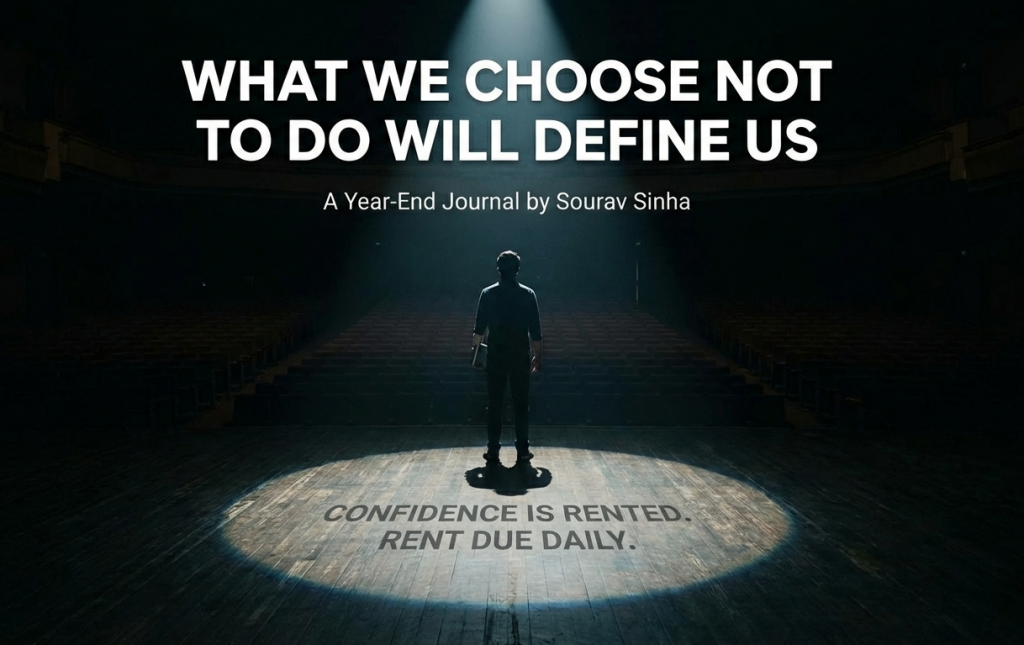
Confidence is not owned. It is rented.
And the rent is due every single day.
Steve Jobs understood this deeply. Every time he walked onto a stage, he looked like the most confident man in the room. But behind that simplicity was obsessive preparation, deep clarity, and brutal honesty about what mattered and what did not.
That lesson has quietly shaped everything I have built since.
Including Brainium.
Why simplicity is not easy and why it matters more than intelligence
One of the biggest myths in corporate life is that intelligence wins.
It does not. Clarity wins.
The smartest teams I have seen are often the most confused. Too many dashboards. Too many meetings. Too many words. Too many PowerPoints explaining things that should take one sentence.
Steve Jobs was ruthless about simplicity because he respected people’s attention.
That is a lesson we must carry into 2026.
If you cannot explain what you are building, why it matters, and who it helps in simple language, then you do not understand it well enough.
And that applies to everyone.
Developers. Designers. Sales. Delivery. Leadership. Including me.
Simplicity is not dumbing down. It is distilling truth.
This year, whenever something felt heavy, delayed, or misaligned at Brainium, the root cause was almost always the same.
We were solving too many problems at once.
Clarity is choosing what not to do.
That takes courage.
The Diamond Way was never about sales
When I wrote The Diamond Way, many people assumed it was a sales book.
It was not.
It was a book about how humans make decisions.
Sales just happens to be the most honest mirror of human behavior. You cannot hide behind titles, tools, or jargon when you are dealing with a real person who has a real problem and real money at stake.
The six angles of the diamond were never a process. They were a way of thinking.
Understand deeply. Qualify honestly. Help proactively. Serve relentlessly. Build trust before asking for it. Earn references by doing real work.
Those principles apply far beyond sales.
They apply to how we write code.
They apply to how we manage timelines.
They apply to how we speak to each other internally.
They apply to leadership.
If there is one thing I want every Brainite to internalize, it is this.
Your job is not your role description.
Your job is to reduce anxiety for someone else.
That someone could be a client. A colleague. A junior. A manager.
When you reduce anxiety, trust grows.
When trust grows, speed increases.
When speed increases, excellence follows.
A hard truth we must accept before moving forward
Let me say something uncomfortable.
Effort is not the same as impact.
Working late does not automatically mean working well.
Being busy is not a badge of honor.
In 2025, many of us worked extremely hard. That deserves respect.
But going into 2026, effort alone will not be enough.
The world does not reward hard work anymore. It rewards leverage.
Leverage comes from clarity, systems, and judgment.
Steve Jobs did not outwork everyone. He out-decided them.
So here is the challenge.
Ask yourself this question honestly.
If I disappeared for two weeks, would things fall apart or would they continue smoothly?
If the answer is that everything would break, then you are not indispensable. You are a bottleneck.
That is not a criticism. That is an opportunity to grow.
Real professionals build systems that work without them breathing down everyone’s neck.
Why writing saved my sanity and why it matters to you
During the lockdown years, when uncertainty was at its peak, I started writing daily.
Not for a book.
Not for LinkedIn.
Not for an audience.
I wrote because my mind was noisy.
Writing gave my thoughts a place to go.
That habit changed how I think, how I lead, and how I listen.
And here is the part most people miss.
Writing is not about grammar or vocabulary.
Writing is thinking on paper.
If you want clarity in your work, write more.
If you want better meetings, write before you speak.
If you want better solutions, write down the problem properly.
Steve Jobs believed that clarity of thought precedes clarity of expression. That belief is deeply aligned with how great engineering and great leadership actually work.
In 2026, I want more Brainites to write.
Design documents. Post-mortems. Ideas. Reflections.
Not for perfection. For clarity.
Humor is not optional. It is survival
Let us talk about humour.
Not sarcasm. Not mockery.
Real humour.
The ability to laugh at yourself is a sign of psychological safety.
Some of my favorite moments this year were not launches or wins.
They were the moments when something broke, someone admitted a mistake, and the room laughed before fixing it.
That is culture.
Steve Jobs was intense, but he was also playful. He understood that creativity dies in fear and flourishes in lightness.
If we cannot laugh during hard days, we will burn out during good ones.
So please carry this forward.
Take your work seriously.
Do not take yourself too seriously.
What I want Brainium to stand for in 2026
Not bigger.
Not louder.
Not busier.
Better.
Better thinking.
Better communication.
Better ownership.
Better judgment.
Better taste.
Taste is underrated.
Steve Jobs spoke about taste often. Taste is knowing when to stop. When enough is enough. When adding more makes it worse.
In code.
In design.
In emails.
In meetings.
In commitments.
Taste comes from caring deeply about the outcome, not about being seen as smart.
A personal note to every Brainite
You do not need to be an extrovert to succeed here.
You do not need to be loud.
You do not need to pretend.
You need to be curious.
You need to be honest.
You need to be dependable.
The rest can be learned.
I have built my entire career by learning on the job, making mistakes, and correcting course.
You will do the same.
Just remember this.
Your character is your warranty.
When people cannot judge the quality of your work immediately, they judge your intent, consistency, and integrity.
That is true for individuals and companies.
As we step into the next year
We are not chasing perfection.
We are chasing progress.
Progress built on clarity.
Progress built on trust.
Progress built on human connection.
If we do that, growth will follow.
And it will be the kind of growth that lasts.
Thank you for showing up in 2025.
Let us build 2026 with a little more courage, a little more humour, and a lot more clarity.
See you on the other side.